
From four legs to flippers
Get up close with the ancient ancestors of the manatee.
From four legs to flippers
Get up close with the ancient ancestors of the manatee.
Jump to timeline
How to use this page
Scroll down the page to discover a different part of the sea cow to manatee evolution.
Unsure of a word?
Check out the vocabulary section at the bottom of the page.
How to pronounce their names
Click the highlighted word to learn how to pronounce it.
Ancestors appear
- Paleocene -
65-56 Million Years Ago
Very early relatives appear on land soon after dinosaurs went extinct.
A common ancestor
- End of Paleocene -
56–55 Million Years Ago
Way back near the end of the Paleocene period, small land animals lived in Africa. They didn’t look like manatees at all.
These land mammals were a common ancestor of sea cows, elephants and hyraxes.
Over time, one branch of this family started edging toward the water…
Chambi Sea Cow
- Eocene -
50 Million Years Ago
Meet the oldest known sirenian, which scientists call the Chambi sea cow.
Fossils of this animal were found in Tunisia, in freshwater deposits, suggesting they lived in or near freshwater.
Part of its skull has been identified, including a section of its ear canal.
The shape of that ear canal reminded scientists of the earliest whales.
This was an important clue that this animal was already adapted to life in water.
We don’t know what the Chambi sea cow looked like. Scientists think it may have been semi-aquatic, meaning it could live in water but also walk on land.

Transitioning to water
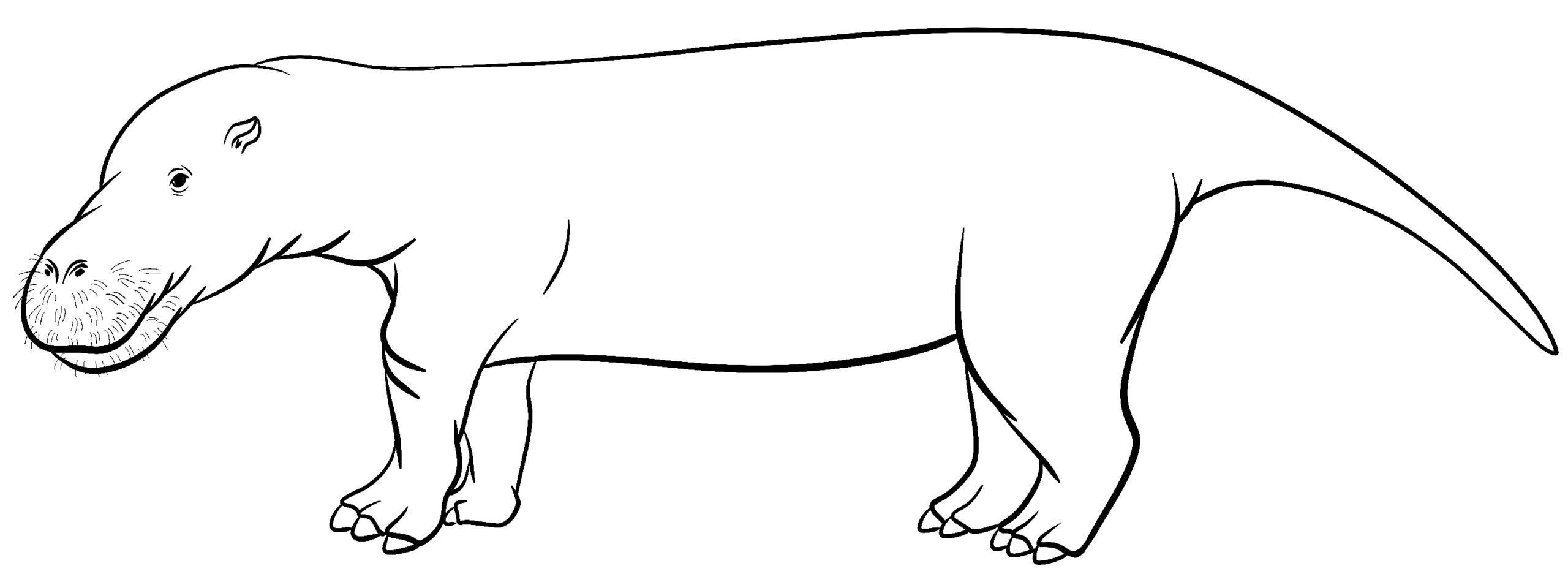
Pezosiren portelli is an important fossil finding because represents a transitional stage between land-walking ancestors and water-living sea cows.
Scientists often describe Pezosiren portelli as looking like a small hippo with the head of a manatee. Looking at the fossil skeleton they think it was likely that Pezosiren ate water plants in shallow coastal rivers.
Walking sea cow
- Early Eocene -
48 Million Years Ago
Another ancient relative of manatees that also lived in Jamaica was Prorastomus.
Prorastomus sirenoides was once thought to be the earliest known sea cow. They were a primitive amphibious animal.
The discovery of this fossil suggested to scientists that sirenians moved from West Africa to the Carribbean by this time.
Crossing the Atlantic
- Oligocene > Miocene -
34 Million Years Ago
Around 34 million years ago, a major extinction event known as the Eocene-Oligocene Extinction Event swept across the planet. Dramatic climate cooling and falling sea levels caused the collapse of many ecosystems in Africa and Europe.
Sea cow populations in these regions were hit hard, with many species dying out entirely. But some populations survived by making an incredible journey, crossing the Atlantic Ocean to the Caribbean and the Americas, where conditions were far more hospitable. These survivors were the ancestors of all living sea cows today.
Settling into South America
- Oligocene > Miocene -
34 - 20 Million Years Ago
Sea cows spread across northern South America, thriving in vast freshwater wetlands. Over millions of years, those wetlands slowly became what we now call the Amazon River Basin.
It was here that the common ancestor of ALL three living manatees: the West Indian, the Amazonian, and the West African eventually evolved. The three species we know today didn’t go their separate ways until much later in time.
So many sea cows!
- Oligocene > Miocene -
22 - 16 Million Years Ago
This was the golden age of sea cows. Lots of different species lived alongside each other across the Caribbean and nearby oceans, each finding their own favourite food and habitat. If you’d visited the Caribbean back then, you might have spotted several completely different kinds of sea cow!
One of the first true manatees...
- Miocene -
16 - 13 Million Years Ago
Introducing Potamosiren magdalenensis one of the earliest true manatees lived in the freshwater wetlands of South America. These are the rivers that would eventually become the Amazon River Basin.
Heading into the Pacific
- Oligocene > Miocene > Pliocene -
25 - 5 Million Years Ago
Before North and South America were fully joined, there was a gap in the ocean between them. Sea cows used this gap to swim into the Pacific Ocean.

One of their descendants became Steller’s Sea Cow. A massive cold-water giant up to 10 metres long. Sadly, when humans discovered it in the 1700s, it was hunted to extinction within just a few decades.
Numbers began to fall
- Miocene > Pliocene -
9 Million Years Ago
From about 9 million years ago, the golden age of sea cows slowly came to an end. Seas changed, climates shifted, and the world looked very different to the one sea cows had thrived in.
Fewer and fewer species survived. But some lineages held on, quietly adapting as the world changed around them.
The manatees we know today are actually relative newcomers to the Caribbean and North Atlantic, a sign of just how adaptable this ancient family has proven to be.
Manatees return to Africa
- Pliocene > Pleistocene > Holocene -
3.5 Million Years Ago
In a brilliant twist, genetic evidence shows that the West African manatee actually crossed the Atlantic FROM the Americas back to Africa around this time. The reverse of what happened 30 million years earlier! It now lives across more than 20 African countries.
Sea Cows alive today
- Holocene > Today >
Today in the year 2026
Look below to learn more about each species and their story.
Dive deeper into each species
Discover what makes them unique 👇


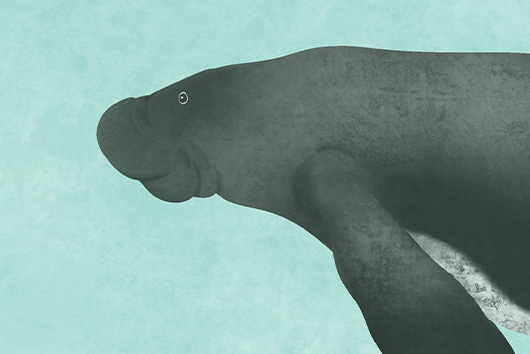
How do you pronounce their names?
Find the name below to see how to pronounce it.
Prorastomus sirenoides
pro-ruh-STOH-mus | sih-ruh-NOY-deez
Pezosiren portelli
peh-zo-SY-ren | por-TELL-ee
Potamosiren magdalenensis
poe-tah-moe-SIGH-ren | mag-dah-len-EN-sis
There's More to a Manatee Than Meets the Eye
Vocabulary
Stuck on a word? Have a look below.
Amphibious able to live both on land and in water.
Ancestor is an animal from the past that a living animal is descended from.
Aquatic living or found in water
Diversity the number of different species living at any one time.
Ear canal the passage inside the ear that helps an animal hear.
Eocene a period of prehistoric time, roughly 56 to 34 million years ago.
Extinction Extinction is the complete disappearance of a species from Earth.
Fossil the preserved remains or traces of an ancient animal or plant, usually found in rock.
Freshwater water that is not salty, such as rivers and lakes.
Freshwater deposits layers of rock or sediment that built up at the bottom of ancient rivers or lakes, where fossils can sometimes be found preserved.
Holocene the current period of time, beginning roughly 11,700 years ago and continuing to the present day.
Lineage a line of animals descended from a common ancestor over time.
Oligocene a period of prehistoric time, roughly 34 to 23 million years ago.
Pleistocene a period of prehistoric time, roughly 2.6 million to 11,700 years ago, often known as the Ice Age.
Pliocene a period of prehistoric time, roughly 5 to 2.6 million years ago.
Sirenia the scientific order that manatees and dugongs belong to.
Species a group of animals that share the same characteristics and can reproduce together.
Subspecies a smaller group within a species that shares specific characteristics.
Temporal lobe a part of the skull near the ear region.
Vestigial a leftover body part no longer needed after millions of years of evolution.