
Why so rare?
On the brink
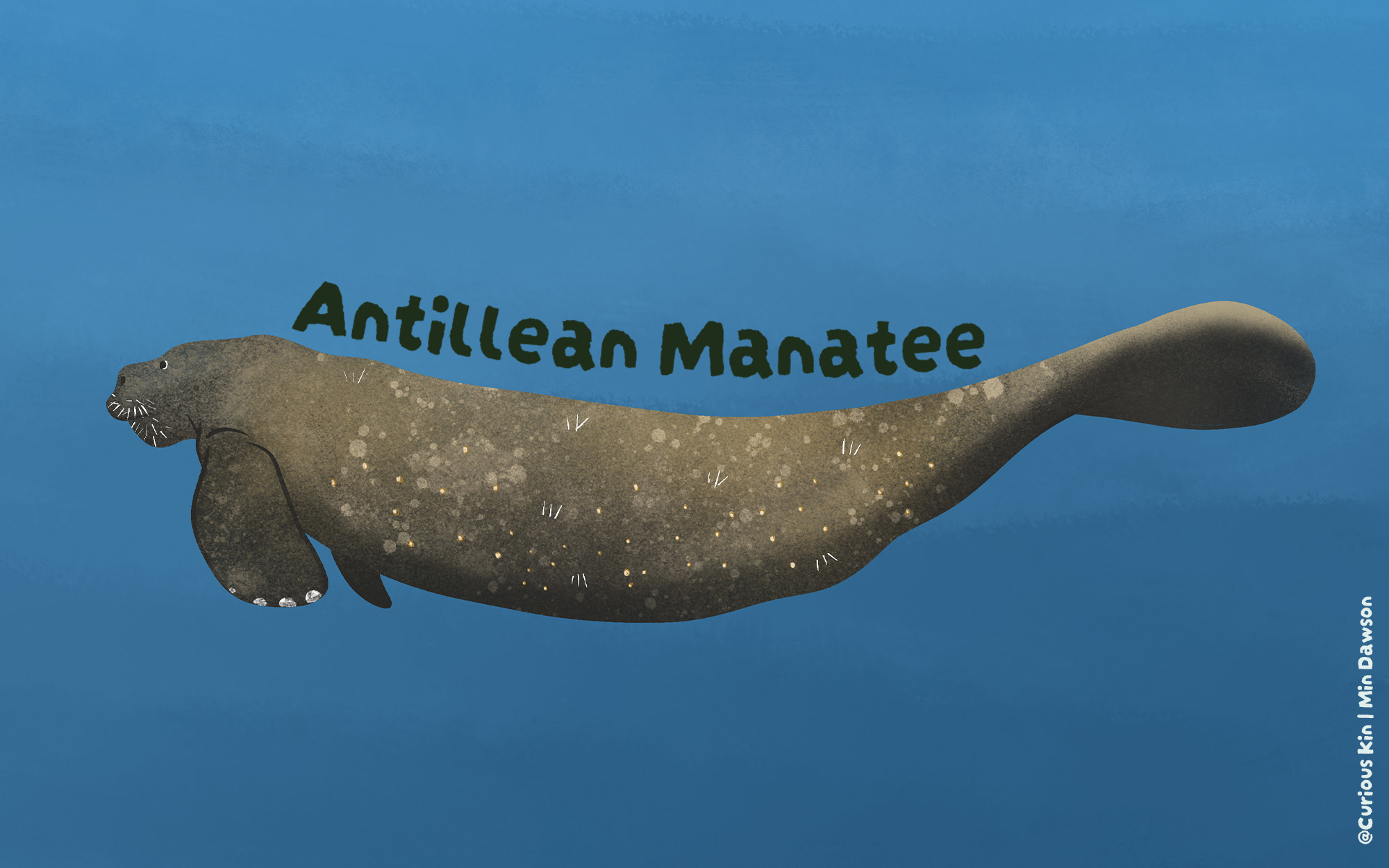
The Antillean Manatee (Trichechus manatus manatus) is one of the lesser-known subspecies of manatee, roaming a vast stretch of the Americas from the warm Gulf of Mexico, through Central America, all the way to northeastern Brazil’s Atlantic coast and the Caribbean’s Greater Antilles.
Shyer and more elusive than their Florida cousins, they favour darker and murkier waterways which makes spotting them incredibly difficult and getting an accurate population count even trickier!
Scientists have also found that some coastal groups specialise in seagrass-heavy diets while freshwater populations have adapted to riverine vegetation, suggesting there may even be distinct ecotypes within the subspecies. What makes them truly special though is just how adaptable they are, making the Antillean Manatee the most versatile of all manatee species.
Despite their adaptability they are an endangered species at risk of extinction.
On this page
Scroll through to uncover the facts, threats, and wonders that shape this elusive gentle giant’s world.
Want to explore the wider manatee family?
| Animal group | Marine Mammal · Sirenia (Sea Cows) |
| Diet | Herbivore — seagrass, mangroves, algae, aquatic vegetation |
| Body length | Approx. 2.8 m (9.2 feet) |
| Weight | 300–800 kg (varies by population) |
| Lifespan | 50 + years in the wild
(often less than 30 due to threats) |
| Location | Gulf of Mexico through Central America, Caribbean, NE Brazil |
| Habitat | Coastal marine, brackish, freshwater: mangroves, seagrass, rivers |
| Population | Unknown (Less than 2,500 mature; fragmented) |
Why so rare?
A mysterious sea cow
The Antillean Manatee (Trichechus manatus manatus) is one of the lesser-known subspecies of manatee, roaming a vast stretch of the Americas from the warm Gulf of Mexico, through Central America, all the way to northeastern Brazil’s Atlantic coast and the Caribbean’s Greater Antilles.
Shyer and more elusive than their Florida cousins, they favour darker and murkier waterways which makes spotting them incredibly difficult and getting an accurate population count even trickier!
Scientists have also found that some coastal groups specialise in seagrass-heavy diets while freshwater populations have adapted to riverine vegetation, suggesting there may even be distinct ecotypes within the subspecies. What makes them truly special though is just how adaptable they are, making the Antillean Manatee the most versatile of all manatee species.
On this page
| Animal group | Mammal · Felidae (Cat family) |
| Diet | Carnivore — Macaques, Gibbons, Pigs, Deer, Birds, Squirrels |
| Body length | Body 2-3 feet (approx 60-92cm) Tail 3 feet (approx 92cm) cm |
| Weight | Males up to 50lb (over 20kg) Females up to 30lb (over 13.5kg) |
| Lifespan | 11 years in the wild |
| Location | Mainland Asia · Islands of Sumatra + Borneo. |
| Habitat | Evergreen tropical forests |
| Population | Up to 10,000 across 2 species |
Scroll through to uncover the facts, threats, and wonders that shape this elusive gentle giant’s world.
Want to explore the wider manatee family?
Fast facts
Top 10 Antillean Manatee Facts
2. Master of murky water
They are experts at staying hidden. Unlike Florida Manatees who love clear bright springs, Antillean Manatees favour darker, murkier waterways.
4. Big appetites
They munch through up to 10% of their body weight in plants every single day.
5. Long distance travellers
They journey hundreds of miles through the seasons, following the rains and floods to find the best food.
6. Brilliant mums
Mothers teach their calves everything: where to find warm water, how to migrate, where to get food and freshwater, and how to stay safe.
7. One calf every 3 years
Calf gestation is 12-14 months. Calves then stay with the mother for up 2.5 years.
8. Different groups, different diets
Coastal populations specialise in seagrass while freshwater groups eat riverine vegetation entirely. Scientists think these could be distinct ecotypes, unique to this subspecies.
9. Streamlined body
Antillean manatees have a more streamlined body than the Florida manatee. They are also considered to be smaller on average.
10. Hippos are a threat
Hippos have been introduced to Colombia’s Magdalena River to control invasive plants but are now competing with manatees for space and food.
Habitat + Range
A story of fragments
The Antillean Manatee once roamed a vast, connected stretch of the Americas.
Today that story is a little more complicated.
You can find the Antillean manatee from the Gulf of Mexico through Central America, down to northeastern Brazil and across the Caribbean’s Greater Antilles. Their range is impressive but populations within it have become increasingly fragmented by habitat loss and human activity.
Adaptability is their superpower.
However adaptable they are, they still have needs. Warm shallow water, plenty of plants to graze on, freshwater nearby and peaceful spots to rest and raise their calves.
Even when those conditions are met, human-caused threats create enormous challenges they must still overcome.
Manatee behaviour
A day in the life
The Antillean Manatee is a gentle, unhurried creature
shaped by the rhythm of the seasons and the tides.
When the wet season arrives and rivers overflow, Antillean Manatees move into flooded forests and plains, grazing on plants usually found on dry land. They make the most of the abundance, eating up to 10% of their body weight a day and building up vital energy reserves for leaner times ahead.
As the dry season returns and water levels drop, manatees retreat to their preferred shallow coastal waters, rivers and lagoons. They seek out warm, sheltered spots of around 20 to 23°C, surfacing regularly to breathe as they rest and forage quietly along the edges of seagrass beds and mangroves, always keeping deeper water close by as a quick escape route.
Diet
Resourceful forager
The Antillean Manatee is a dedicated herbivore with one of the most varied diets of any manatee species.
They graze on a huge range of aquatic plants (some report over 60) including submerged and floating vegetation, whatever their habitat has to offer!
On a good day they can eat up to 10% of their body weight, which for a fully grown adult means getting through up to 55 kg of plants.
In the wet season, rising floodwaters open up new grazing areas and manatees will take full advantage of whatever plants are newly available.
Unlike the Amazonian manatee the Antillean manatee eats year round, moving to where food is abundant.
Known plant foods include:
Seagrasses
Algae
Water Hyacinth
Cattail
Water lily
Different populations eat quite differently from one another.
Coastal groups tend to specialise in seagrass while freshwater populations adapt to the riverine plants in their local waterways.
Scientists think this points to distinct ecotypes within the subspecies, each shaped by their environment.
Challenges Antillean manatees face
Threats and dangers
Habitat loss
The biggest threat of all. Forests along riverbanks are being cut down, seagrass meadows destroyed, farming practises are washing too much soil away causing the rivers to change and the plants to disappear.
Being spread too thin
When manatee populations are broken up into small, isolated groups, it becomes harder for them to breed and recover from any losses.
Pollution
Chemicals used in farming like those used to grow sugar cane near Mexico’s Hondo River can pollute the water manatees live in.
Hunting
Even though it is illegal, some manatees are still hunted for meat, particularly in some parts of their range where laws are harder to enforce.
Hippos
Hippos have been introduced to Colombia’s Magdalena River to control invasive plants but are now competing with manatees for space and food.
Fishing nets
Manatees can become caught in fishing nets and lines. Unable to reach the surface to breathe, this can be fatal.
Boat traffic
Manatees are sensitive to boat noise, which causes stress and changes their behaviour. Boat strikes are a growing concern as river traffic increases.
Meet the others
More than just one species
There are in fact three species of manatee: the West Indian, West African and Amazonian. The West Indian manatee has two sub-species: the Antillean and the Florida manatee.
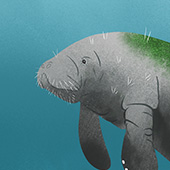
Florida Manatee
Trichechus manatus
Meet the largest species of manatee, the Florida manatee a sub-species of the West Indian.
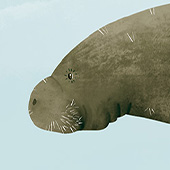
West African Manatee
Trichechus senegalensis
The West African manatee is slightly smaller than the West Indian. They are known travel up river as far as Chad and Niger.
Vocabulary
Stuck on a word? Have a look below.
Ecotype a group within a species that has adapted to a specific local environment, distinct but not a separate species.
Aquatic living or found in water
Estuary where a river meets the sea, mixing fresh and salt water.
Floodplain flat land alongside a river that floods during heavy rainfall or seasonal water rises.
Gestation period the length of time a baby develops inside its mother before being born.
Grazing feeding on plants slowly and continuously over a period of time.
Herbivore an animal that only eats plants.
Lagoon a shallow stretch of water separated from the sea by a sandbank or reef.
Marine mammal a warm-blooded animal that lives in or around the sea and breathes air.
Metabolic rate the speed at which a body uses energy to keep itself alive.
Migrate to travel from one place to another with the seasons.
Natural spring a place where water flows naturally up from underground to the surface.
Seagrass meadow underwater fields of grass-like plants that grow in shallow coastal waters.
Sirenia the scientific order that manatees and dugongs belong to.
Solitary living or spending time alone rather than in a group.
Subspecies a smaller group within a species that shares specific characteristics.
Vestigial a leftover body part no longer needed after millions of years of evolution.
Page notes
This content reflects the most accurate and up-to-date information available at the time of publication. The author strives to incorporate the latest research findings, but scientific knowledge evolves continuously with new discoveries and publications. Curious Kin accepts no liability for any inaccuracies or changes arising from subsequent studies.
Any videos and resources shared here have been carefully selected with the animals’ welfare at heart, not tourism.