
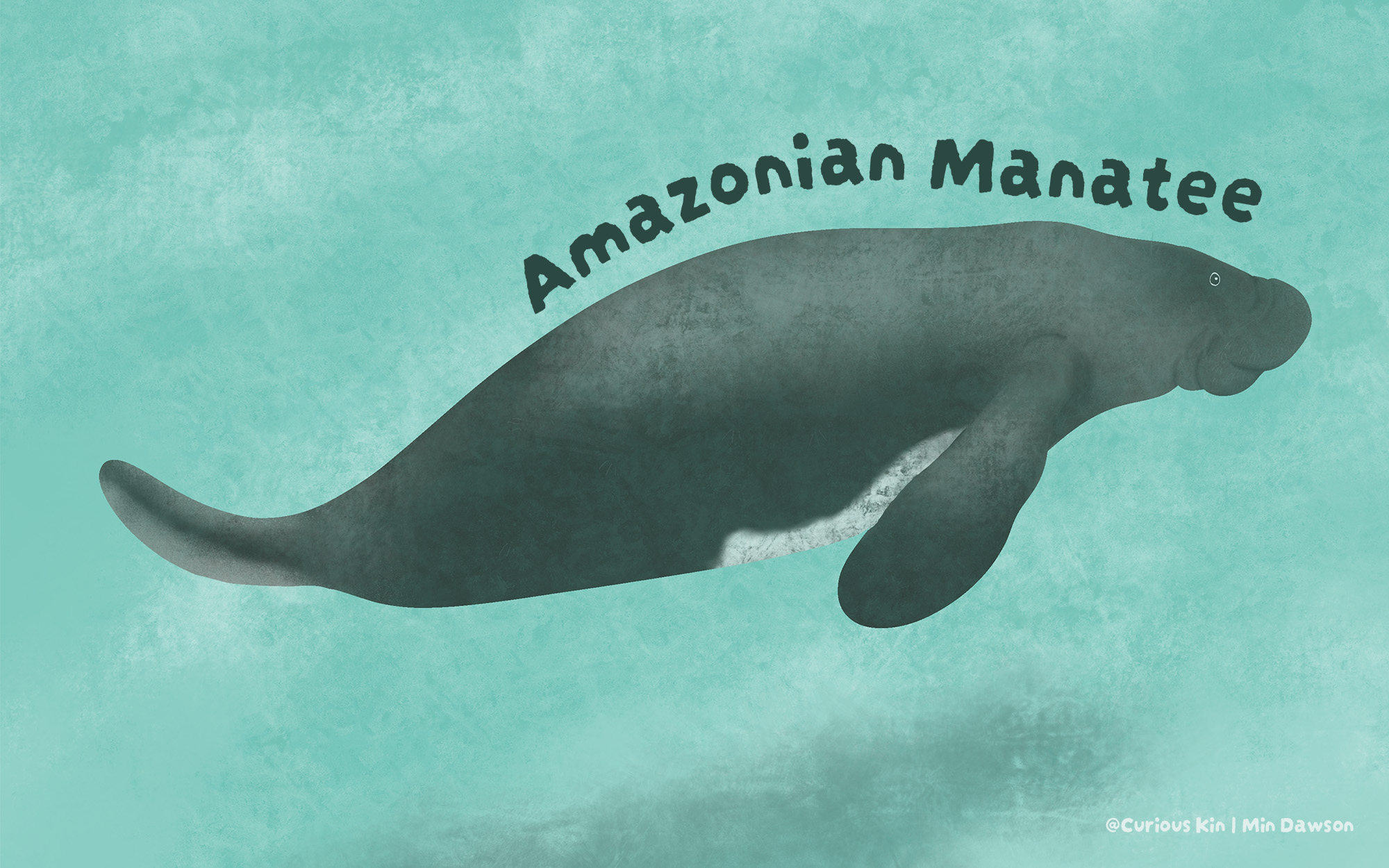
Why so rare?
A mysterious sea cow
The Amazonian manatee is one of the lesser known species of manatee. They spend almost their entire life deep in the Amazon river basin, moving between lakes and flood plains along the main river ways. The water in the Amazon river is murky, making it much harder to spot them, thus getting an accurate population count is even trickier!
On this page
Scroll through to uncover the facts, threats, and wonders that shape this elusive gentle giant’s world.
Want to explore the wider manatee family?
| Animal group | Marine Mammal · Sirenia (Sea Cows) |
| Diet | Herbivore — Aquatic plants |
| Body length | Approx. 2.8 m (9.2 feet) |
| Weight | Approx. 420 kg (926 lb) Just under half a tonne |
| Lifespan | 50+ years in wild |
| Location | Brazil, Colombia, Ecuador, Peru (with possible range extensions) |
| Habitat | Rivers, swamps, wetlands, lakes and floodplains of the Amazon River Basin |
| Population | Debated |
Why so rare?
A mysterious sea cow
The Amazonian manatee is one of the lesser known species of manatee. They spend almost their entire life deep in the Amazon river basin, moving between lakes and flood plains along the main river ways. The water in the Amazon river is murky, making it much harder to spot them, thus getting an accurate population count is even trickier!
On this page
| Animal group | Mammal · Felidae (Cat family) |
| Diet | Carnivore — Macaques, Gibbons, Pigs, Deer, Birds, Squirrels |
| Body length | Body 2-3 feet (approx 60-92cm) Tail 3 feet (approx 92cm) cm |
| Weight | Males up to 50lb (over 20kg) Females up to 30lb (over 13.5kg) |
| Lifespan | 11 years in the wild |
| Location | Mainland Asia · Islands of Sumatra + Borneo. |
| Habitat | Evergreen tropical forests |
| Population | Up to 10,000 across 2 species |
Scroll through to uncover the facts, threats, and wonders that shape this elusive gentle giant’s world.
Want to explore the wider manatee family?
Fast facts
Top 10 Amazonian Manatee Facts
2. Their latin name ‘Inunguis’ means ‘no nails’
They are the only species without vestigial nails on their flippers.
4. Survives up to 7 months with little or no food
When food is scarce in the dry season, they rely on their fat reserves and low metabolic rate.
5. Feeds on surface and emergent plants
Unlike the other species of manatee that primarily feed on submerged aquatic plants, most of the Amazonian manatees feeding is done on the surface.
6. A single calf every 4 years
Expectant mothers have a gestation period of 13 months. It is very rare for mothers to bear twins.
7. Calves are nursed for up to 2 years
Mothers are very attentive teaching calves the right foods to eat and how to swim
8. Individuals have unique belly patches
Amazonian manattes have distinctive white or pinkish patches on their belly. Like a fingerprint.
9. Moving with the seasons
They follow the Amazon’s annual flood cycle moving into flooded forests in the wet season and retreating to deeper waters in the dry season,
10. Active both day and night
Manatee behaviour
A day in the life
The Amazonian manatee is a gentle slow moving creature
shaped by the rhythm of the Amazon.
When water rises across flood plains it opens up flooded forests and meadows packed with aquatic vegetations. The manatees will take full advantage eating between 5-15% of their body weight per day. They are building up vital fat reserves for the dry season ahead.
Dry seasons come around July and August when water levels drop significantly. Some manatees become isolated in deep lakes while others have made their way back to the river channels where they meet up. Food is now scarce and many manatees enter a state of near fasting. Where they are sustained by their fat stores and very low metabolic rate.
Diet
Not a picky eater
A dedicated herbivore the Amazonian manatee is known to eat over 40 different types of aquatic plant and occasional fallen palm fruit.
Known plant foods include:
Water lettuce
Water hyacinth
Bladderwort
Hornwort
Water lily
Challenges Amazonian manatees face
Threats and dangers
Dam construction in Brazil
Has altered river flow and habitat, disrupting the seasonal flood patterns that manatees depend on for feeding and migration.
Logging in Peru
The debris from cutting down trees clogs lakes and blocks seasonal migration routes cutting manatees off from feeding grounds.
Habitat loss + deforestation
Has led to soil erosion which has affected the water quality and reduced the amount of aquatic plants. Directly affecting the manatee’s food supply.
Mining & mercury pollution
Mining operations can release mercury deposits into waterways. This is absorbed by awuatic plants and then eaten by manatees, building up in their bodies overtime.
Oil pollution
Oil extraction and spills in riverways introduce toxic pollutants that contaminate both the water and vegetation manatees rely on.
Fishing nets
Manatees can get accidentally entangled and drown in fishing nets. This sometimes also results in orphaned calves who are extremely vulnerable.
Boat traffic
Manatees are sensitive to boat noise, which causes stress and changes their behaviour. Boat strikes are a growing concern as river traffic increases.
Illegal pet trade
Orphaned calves (that have been left behind after net entanglement or poaching) may be taken and sold as exotic pets. It is illegal but continues to happen.
Conservation notes
Protected by law
Amazonian manatees are protected by law in all range countries, but enforcement is inconsistent.
Conservation challenges
Lacking accurate population data because of the difficult surveying murky remote Amazonian waterways.
Slow reproduction means populations cannot recover quickly from losses
Long held community views see manatees as a food source.
Historic hunting
Hunting for meat and oil has devastated Amazonian manatee populations since the 17th century. Between 1935 and 1954 an estimated 4,000-10,000 indivduals were killed in Brazil alone.
Conservation Wins
Orphaned calf rescue + rehab programmes are an important conservation tool in Brazil and Colombia.
Protecting areas of land helps to protect crucial wildlife habitats and prevent wild fires and deforestation.
Research + monitoring helps to collect vital data and build up a more accurate picture of what is happening.
Habitat restoration is vital and includes replanting thousands of trees.
Meet the others
More than just one species
The Amazonian manatee is one of three species of manatee.
West Indian Manatee
Trichechus manatus
The largest of the three species, the West Indian manatee has 2 sub-species the Antillean and Florida manatee.
West African Manatee
Trichechus senegalensis
The West African manatee is slightly smaller than the West Indian. They are known travel up river as far as Chad and Niger.
Vocabulary
Stuck on a word? Have a look below.
Ecotype a group within a species that has adapted to a specific local environment, distinct but not a separate species.
Aquatic living or found in water
Estuary where a river meets the sea, mixing fresh and salt water.
Floodplain flat land alongside a river that floods during heavy rainfall or seasonal water rises.
Gestation period the length of time a baby develops inside its mother before being born.
Grazing feeding on plants slowly and continuously over a period of time.
Herbivore an animal that only eats plants.
Lagoon a shallow stretch of water separated from the sea by a sandbank or reef.
Marine mammal a warm-blooded animal that lives in or around the sea and breathes air.
Metabolic rate the speed at which a body uses energy to keep itself alive.
Migrate to travel from one place to another with the seasons.
Natural spring a place where water flows naturally up from underground to the surface.
Seagrass meadow underwater fields of grass-like plants that grow in shallow coastal waters.
Sirenia the scientific order that manatees and dugongs belong to.
Solitary living or spending time alone rather than in a group.
Subspecies a smaller group within a species that shares specific characteristics.
Vestigial a leftover body part no longer needed after millions of years of evolution.
Page notes
This content reflects the most accurate and up-to-date information available at the time of publication. The author strives to incorporate the latest research findings, but scientific knowledge evolves continuously with new discoveries and publications. Curious Kin accepts no liability for any inaccuracies or changes arising from subsequent studies.
Any videos and resources shared here have been carefully selected with the animals’ welfare at heart, not tourism.