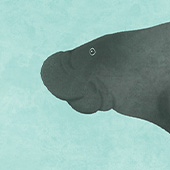
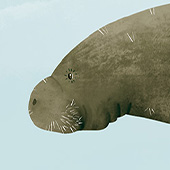
The Florida Manatee (Trichechus manatus latirostris) is perhaps the most well-known of all manatee subspecies and Florida’s much-loved state marine mammal. Bigger and bolder than their Antillean cousins, they are famously unphased by humans, making them one of the most studied marine mammals in the world. But with boat strikes the number one cause of injury and death, and habitats under growing pressure, their story still needs a happy ending.
On this page
Scroll through to uncover the facts, threats, and wonders that shape this elusive gentle giant’s world.
The Florida Manatee (Trichechus manatus latirostris) is perhaps the most well-known of all manatee subspecies and Florida’s much-loved state marine mammal.
Bigger and bolder than their Antillean cousins, they are famously unphased by humans, making them one of the most studied marine mammals in the world.
But with boat strikes the number one cause of injury and death, and habitats under growing pressure, their story still needs a happy ending.
5. 96% of Florida manatees have scars caused by boat strikes
6. Can eat up to 100lb of plants a day
7. Loves winter warmth from power stations
8. Rests up to 12 hours a day, surfacing every 5 minutes
9. One calf every 2 to 5 years
10. Alligators stay clear of manatee adults
Manatee behaviour
A day in the life
The Florida manatee is a creature of simple pleasures. Good food, warm water and plenty of rest.
They spend around 6 to 8 hours a day grazing before floating off to rest, surfacing every few minutes to breathe. They are mostly solitary but are quite happy in relaxed groups of up to 20, particularly around favourite warm water spots.
Unlike most wildlife, they are remarkably unbothered by humans, which makes them a joy to encounter but also puts them at greater risk from boat traffic.
It is illegal to touch a manatee.
Seasonal movements
Following the warmth
Florida Manatees are creatures of habit when it comes to the seasons.
In summer they spread out, roaming rivers and bays as far north as Georgia and Alabama in search of food.
As temperatures drop, they head back south to one of 20 or more warm water refuges.
These might be natural springs or the warm outflows of power stations. Where they stay put until spring arrives.
Diet
Seagrass
Florida Manatees are dedicated herbivores with a serious appetite. Seagrass makes up the bulk of their diet particularly turtle grass and shoal grass.
They eat between 4 and 9% of their body weight every single day, which for a large adult can mean getting through up to 50kg of plants.
When seagrass beds are healthy, Florida Manatees thrive. When they are not, the whole population feels it.
Known plant foods include:
Algae
Water hyacinth
Mangrove leaves
Challenges Florida manatees face
Threats and dangers
Boat strikes
Number 1 cause of florida manatee injury and deaths.
Planned closures
When power plants close manatees lose a source of warmth in the winter.
Algae blooms
Destroy seagrass beds leaving manatees without food.
Red tide toxins
Threaten the wellbeing of Florida manatees.
Human harrassment
Poorly managed wildlife encounters disturb manatees and disrupt feeding, resting and calf-rearing
.Habitat loss
Coastal development destroys the seagrass meadows, mangroves and warm water refuges manatees rely on.
Intentional killings
Despite being protected by law, illegal killings still occur and remain a persistent threat.
Meet the others
More than just one species
Florida manatee is one of two sub-species of the West Indian manatee. There are also 2 other species of manatee:
Amazonian Manatee Trichechus inunguis
The smallest of the three species, the Amazonian manatee lives deep in the Amazon river basin.
West African Manatee Trichechus senegalensis
The West African manatee is slightly smaller than the West Indian. They are known travel up river as far as Chad and Niger.
Still have questions?
Dive deeper into the world of manatees
quick read opens here
full page goes to a new page
Vocabulary
Stuck on a word? Have a look below.
Ecotype a group within a species that has adapted to a specific local environment, distinct but not a separate species.
Algae bloom a rapid growth of algae in water, often triggered by warm temperatures or excess nutrients, which can reduce oxygen levels and harm aquatic life.
Aquatic living or found in water
Estuary where a river meets the sea, mixing fresh and salt water.
Floodplain flat land alongside a river that floods during heavy rainfall or seasonal water rises.
Gestation period the length of time a baby develops inside its mother before being born.
Grazing feeding on plants slowly and continuously over a period of time.
Herbivore an animal that only eats plants.
Lagoon a shallow stretch of water separated from the sea by a sandbank or reef.
Marine mammal a warm-blooded animal that lives in or around the sea and breathes air.
Metabolic rate the speed at which a body uses energy to keep itself alive.
Migrate to travel from one place to another with the seasons.
Natural spring a place where water flows naturally up from underground to the surface.
Seagrass meadow underwater fields of grass-like plants that grow in shallow coastal waters.
Sirenia the scientific order that manatees and dugongs belong to.
Solitary living or spending time alone rather than in a group.
Subspecies a smaller group within a species that shares specific characteristics.
Vestigial a leftover body part no longer needed after millions of years of evolution.
Page notes
This content reflects the most accurate and up-to-date information available at the time of publication. The author strives to incorporate the latest research findings, but scientific knowledge evolves continuously with new discoveries and publications. Curious Kin accepts no liability for any inaccuracies or changes arising from subsequent studies.
Any videos and resources shared here have been carefully selected with the animals’ welfare at heart, not tourism.