
There's More to a Manatee
Than Meets the Eye
Keep reading to uncover the secrets to why they are so well adapted to shallow waters👇
There's More to a Manatee Than Meets the Eye
Keep reading to uncover the secrets to why they are so well adapted to shallow waters👇
Eat, Graze, Repeat
Discover how a manatee is able to chow down on so much tough vegetation.
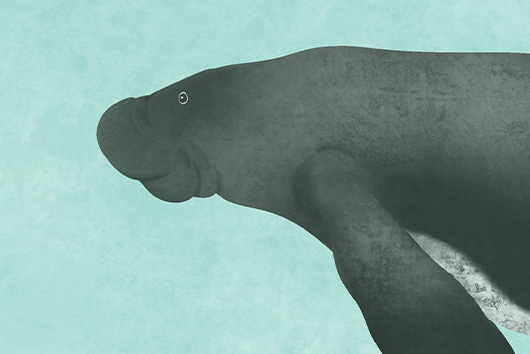
Prehensile lips Manatees have large flexible lips that split into 2 lobes. They can work independent of each other to grip onto food.
Lip bristles are stiff bristles that are sensors helping the manatee to feel around and push food into their mouths.
Marching molars Manatees don’t have just one set of teeth. Instead their teeth get replaced, slowly shuffling forward from the back of the jaw and replace themselves forever.
Unique digestive system manatees rely on their super long intestines and cecum to digest food.


Exploring through their senses
Vibrissae sparse sensory hairs covering their whole body that can detect the tiniest movements and vibrations in the water
Lip bristles not just for eating, these help manatees sense and explore everything around them.
Small eyes manatees have a nictitating lens, a see-through inner eyelid that protects their eyes underwater, like built-in swimming goggles.
Built to glide
Manatees might look like they’re just floating around doing nothing, but their body is brilliantly designed for life in the water:
Flexible forelimbs used for steering, crawling along the seabed and even cuddling their young.
Dense heavy bones act like natural ballast, helping manatees stay perfectly balanced underwater without any effort
Paddle tail a broad, flat, paddle-shaped tail that powers them through the water with slow, powerful strokes.
Nostrils on top of their snout perfectly positioned for a quick breath at the surface without breaking their stride.
Muscular nose valves nostrils that snap shut like tiny trapdoors the moment they dive back under.
No so tough on the outside
Although a manatee’s skin is thick and tough, it scars easily. Boat strikes are one of the biggest threats to manatees and often leave severe and permanent scarring. In fact, scientists use scar patterns to identify individual manatees in the wild. Another reason to slow your boat down.
Thick wrinkly skin is up to 5cm thick. It’s tough and protective, often home to algae and barnacles hitching a ride.
Flaky skin constantly shedding and renewing, keeping their skin clean and healthy
Inside, it gets really interesting
Long horizontal lungs run the full length of the back, helping with buoyancy control. This makes them especially vulnerable to injury.
Reniculate kidneys multi-lobed super kidneys that let manatees switch seamlessly between saltwater and freshwater
Super long intestines Their intestines can be up to 45 meters long. They squeeze every last bit of goodness out of even the toughest plants.

Dive deeper into each species
Discover what makes them unique 👇


Vocabulary
Stuck on a word? Have a look below.
Aquatic living or found in water
Ballast weight that helps keep something stable and balanced.
Bouyancy the ability to float or stay at a certain depth in water.
Estuary where a river meets the sea, mixing fresh and salt water.
Lagoon a shallow stretch of water separated from the sea by a sandbank or reef.
Herbivore an animal that only eats plants.
Nictitating lens a transparent eyelid that protects the eye underwater.
Marine mammal a warm-blooded animal that lives in or around the sea and breathes air.
Migrate to travel from one place to another with the seasons.
Prehensile able to grip and hold, like fingers
Seagrass meadow underwater fields of grass-like plants that grow in shallow coastal waters.
Sirenia the scientific order that manatees and dugongs belong to.
Subspecies a smaller group within a species that shares specific characteristics.
Reniculate Kidney instead of one kidney, manatees have kidneys made up of lots of tiny individual kidneys all bundled together, each one doing its own job.
Vibrissae are tiny hair sensors that pick up movement and vibrations covering the manatees body and mouth.
Vestigial a leftover body part no longer needed after millions of years of evolution.